If your website isn’t generating the leads you expected, it’s time to take a closer look. For any small business, your website is always on and should be helping your customers to get in touch with you.
However, many websites fail to convert visitors to leads, leaving you with website traffic but not the results you’re looking for. If you’re wondering “why is my website not generating leads?”, it’s time to take a closer look at what might be going wrong and how to fix it.
Why websites fail to generate leads
Before you can make improvements, it’s important to understand why your website might not be generating leads. Trust can be a big factor, along with how easy a website is to use or navigate. A poorly designed website might leave people feeling confused, unable to find what it is they’re looking for or questioning if your website is legitimate.
Your website might not be generating leads because you aren’t guiding visitors effectively once they’re on site. A call to action (CTA) is a prompt that encourages website visitors to take a specific action, such as booking a call, signing up for a newsletter or making a purchase. If your CTAs are unclear, hard to find or lack urgency, your visitors may not know what to do next.
Even the best-designed website won’t generate leads if no one sees it. If your site isn’t ranking well in search engines or isn’t promoted through the right channels, you might not be attracting enough visitors to convert into leads in the first place.
How to improve lead generation on your website
The good news is that you can improve lead generation on your website. Sometimes just making a few tweaks can completely change how many leads you get into your business. Here are some ways that you can take action when it comes to generating new business leads (without having to start from scratch).
Optimise your landing pages
A landing page is a standalone web page designed to get visitors to take action, for example, signing up for a newsletter or buying a product. This is often the first page they arrive on, and optimising a landing page means making improvements to increase how people take action on your website.
There are some key improvements that you can make to optimise your landing pages:
- Laying out information with clear headlines and subheadings that make it easy for visitors to understand what they’ll gain by taking action.
- Using persuasive language that explains the benefits of what you have to offer and why it’s valuable to the audience.
- Making sure that you have a simple, uncluttered website design that focuses on the main CTA and conversions.
- Adding testimonials, reviews or case studies that show the benefits of your products or services.
Make it easy for visitors to contact you
You know where your contact information is on your website, so it’s easy for you to find. Get someone else – who doesn’t know your website well – to check how easy it is to find and get in touch. For example, a typo in an email address is easily done and straightforward to fix but can have a massive impact on generating business leads.
The same can be said for contact forms too. If they’re too long, complicated or not working properly, visitors might abandon them before they hit submit. Make forms easy to find and as simple as possible to complete and send.
Let visitors know their data is secure when they contact you. This could be as simple as including a privacy statement or mentioning that you’ll never share their details. Data protection is the law so you need to make sure you follow the rules.
Make your calls to action clear and engaging
As we mentioned earlier, your CTAs are the driving force when it comes to generating new business leads. You need to put some thought into them, make sure that they’re in the right place on the page and that you’ve given a reason to take the next step.
Add your CTAs in prominent areas such as at the top of the page, within the content and at the end of your blog posts or product pages. Use persuasive, action-based language to give them a reason to continue. This could mean that instead of ‘submit,’ try something more persuasive, like ‘Get Your Free Guide’ or ‘Book Your Free Consultation.’ Phrases like ‘Limited Time Offer’ or ‘Sign Up Now to Get Exclusive Access’ can help to encourage more action too.
The role of SEO, content and paid media in lead generation
Generating leads online starts with three key elements: SEO, content and paid media. These all help people to find out about your business – and find your website – in the first place..
Let’s take a closer look at these lead generation opportunities and how you can make sure that they work for your business.
SEO (Search Engine Optimisation)
SEO helps your website appear higher in search results, making it easier for potential customers to find you. By using the right keywords and improving your site’s structure, you can attract organic traffic and increase visibility.
Make sure your website and landing pages are optimised with the right keywords that your target audience is searching for. You’ll need to do a little research to get this right, and to make sure that you use your keywords in the right places, but it can be seriously effective for your business. Google prioritises fast-loading websites, so make sure your pages load quickly too.
Optimise your page titles, meta descriptions, header tags and images for search engines too. Again, this is about using the right keywords and descriptions across your website, even in the places that potential customers might not notice, to make sure that search engines can find your website and work out what it’s about.
Valuable content
Content plays a big role in keeping visitors engaged and building trust. Use relevant and informative content across your website to support your business goals and provide useful information for visitors. Blogs, case studies, eBooks, videos and testimonials can all be used to educate, inform and engage your audience. The more valuable and helpful your content is, the more likely people will trust you with their contact information.
You can also use content to generate leads, by collecting email addresses in exchange for access to the information. Use this strategy wisely as it has to be information that visitors think is worth handing their details over for. You also need to make sure that you get the right permissions to contact them if you use this tactic.
If you need some ideas of what content to add to your website, think about what’s useful for the audience. Here are some ideas you can use for your website:
- Hairdressers – blog posts about taking care of different hair types or styles
- Locksmiths – a checklist on how to improve home security or what to do if you’ve been locked out
- Plumbers – seasonal home maintenance checklist
- Landscapers or gardeners – a planting calendar for the local climate or a guide to low-maintenance garden designs.
- Nail technicians – downloadable nail care guide or a colour chart with seasonal nail trends.
- Mechanics – a seasonal “Car Maintenance Checklist” or a guide to spotting common issues before they become costly repairs.
Read: Our Blog Helps Us Build Trust and Gain Leads from PGS London Plumbers to find out how this business used content to drive leads.
Paid media
Paid media like Google and Facebook ads can drive targeted traffic to your website. When running paid ads you need to make sure that you’re targeting the right people by using options like location, interests and demographics. Spending money to generate leads isn’t worthwhile if it isn’t the right audience who are getting in touch.
Once a potential customer clicks through, your ad should lead to a landing page that directly matches the offer in the ad. This creates a consistent experience for the user and can help to improve conversions. You wanto to keep an eye on your ad spend and return on investment (ROI) too.
How to improve your conversion rate
Conversion rate optimisation (CRO) is about making small changes that lead to big results in terms of converting visitors into leads, and then customers. Here are a few strategies to boost conversions:
A/B testing is a method of comparing two versions of a webpage, ad or email to see which one performs better by showing each version to different audiences and measuring the results. This could be testing different headlines, images, CTA buttons or layouts. By continually testing and optimising, you can improve the effectiveness of your website in
If your website isn’t guiding users from one step to the next, they may get lost or frustrated. This is known as user flow, and it’s another thing you can optimise. Make sure there are clear paths to conversion on every page, and that it’s easy for visitors to take the next step
Your website should be easy to navigate, especially for first-time visitors. If your visitors can’t find what they’re looking for quickly, they’re likely to leave. Keep your navigation simple and intuitive, with clear categories, labels and search options. The easier it is for visitors to find the information they need, the more likely they are to convert.
Check how your website is performing
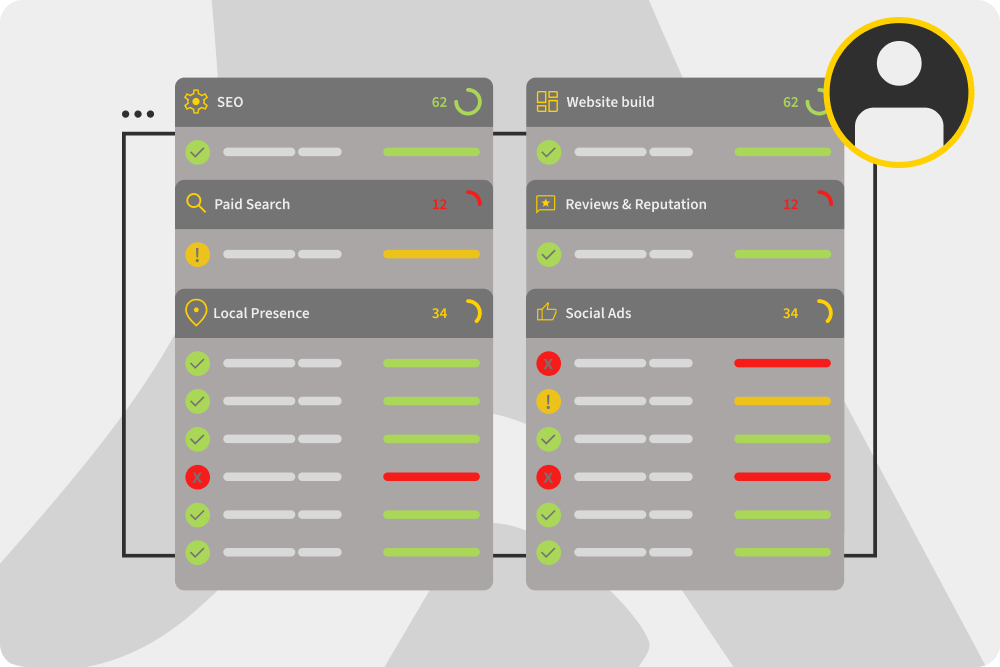
Want to find out how your website is performing? Our free website checker scans your website to check how effective your website is and whether it stands out online. You’ll get your report in less than 60 seconds, along with guidance on how to improve your website and digital presence.
You can also find more tips on digital marketing for your business in our free Digital Marketing Guide, available to download now.