Artificial intelligence (AI) is transforming how people choose local businesses. Instead of scrolling through endless Google results, more customers are asking tools like ChatGPT, Gemini and Copilot to simply recommend a trusted business.
Traditional SEO still matters – but AI search works differently. Instead of just assessing keywords and backlinks, AI tools scan everything about your online presence. They cross-check your details, look for signs that you’re active and trustworthy, analyse reviews and imagery, and build a complete picture of your business before deciding whether to recommend you.
Fun fact: AI models can analyse thousands of signals in under a second. A single outdated phone number or abandoned social media page can quietly weaken your trust score.
The good news is that becoming “AI-ready” is much simpler than it sounds – no technical expertise required. Just follow the six steps below.
Optimise your Google Business Profile
Your Google Business Profile (GBP) is often the first place AI checks to confirm who you are, what you do and whether you’re reliable. It’s your digital shopfront – and AI tools examine far more than your address and phone number.
They look at your opening hours, categories, photos, services, reviews and even how long your listing has existed.
Top tip:
Pick the most specific primary category available. It’s one of the clearest signals AI uses to understand what you actually do. Choose wrong, and it’s like placing your Yellow Pages ad in the wrong section – you’re technically there, but no one who needs you will find you.
What NOT to do:
Don’t treat your GBP as something you set up once and forget. Outdated hours or missing services quietly tell AI your business may not be active.
Keep your business details consistent
AI doesn’t just check your website or Google listing – it checks everything. Your details must match across:
- Bing
- Social media
- Review platforms
- Online directories
- Mapping tools
- Old pages you forgot existed
If your business name, address or phone number varies even slightly, AI may treat you as multiple companies or assume the information is unreliable. Nothing hurts visibility faster than a confused algorithm.
AI tools often cross-reference 10-20 different directories to confirm that you are who you say you are.
Top tip:
Search your business name on Google and tidy up old listings or pages you no longer use. An old Facebook page you haven’t touched in years can weaken your consistency signal without you knowing.
What NOT to do:
Don’t use slightly different business names across platforms (for example ‘Smith & Sons Heating Services’ vs ‘Smith’s Heating Services’). AI won’t merge them – it’ll think they’re separate companies and split your trust signal.
Write clear, helpful content
AI is smart, but it still needs depends on clear explanations. If your website is packed with jargon, unexplained abbreviations or vague marketing phrases, AI simply can’t match your business to what real customers are searching for.
Clear, plain-language descriptions help both humans and AI.
Example of jargon:
“We provide comprehensive property maintenance solutions.”
Clear, AI-friendly version:
“We fix leaking roofs, repair brickwork and handle general home repairs.”
Adding short explanations of specialist terms is surprisingly powerful. FAQs are even better, because they mirror the question-and-answer structure AI tools use.
AI also looks for clarity on who your services are designed for. A simple line like ‘Ideal for landlords’ or ‘Perfect for older homes’ helps AI match you to specific search intents.
Top tip:
Write as if you’re explaining your services to a friend for the first time. If it feels too clever, simplify it.
What NOT to do:
Don’t assume AI will ‘figure out’ cryptic or overly technical content. If a human would need to Google it, AI won’t confidently recommend you.
Ask for reviews – and reply to them
Reviews signal trust. A steady flow of genuine, recent reviews shows that your business is active, reliable and providing real value.
AI tools don’t just count reviews – they read them. They scan for:
- Services mentioned
- Locations mentioned
- Sentiment (positive, neutral or negative)
- How recently reviews were posted
- How often you reply
If all your reviews mention boiler repairs, AI might assume that’s your only service – even if your website lists 10 more.
Top tip:
When you ask for a review, invite customers to mention the specific service they received. It helps AI build a more accurate picture of your business.
What NOT to do:
Don’t ignore your reviews, especially the negative ones. A business that never responds can look inattentive, and AI picks up on that pattern.
Refresh your website regularly
AI models value freshness. A website that hasn’t changed for years signals that the business may not be active. Small updates count:
- New photos
- Updated service descriptions
- Clearer explanations
- Fresh FAQs
- Rewritten, human-friendly content
- New blog posts
AI even analyses your image file names. IMG_1234.jpg tells AI nothing. kitchen-fitters-manchester.jpg tells AI exactly what it’s looking at.
Duplicate content is another hidden issue – AI tends to skip repetitive pages altogether.
Top tip:
Update at least one element of your website each month, and rename images with descriptive, human-friendly filenames.
What NOT to do:
Don’t let your site gather digital dust. Stale or duplicate content sends the wrong signals.
Make your website fast and mobile-friendly
Speed and usability are huge trust indicators for both Google and AI systems. If your site loads slowly or feels clunky on a phone, AI assumes your customer experience will be poor – and is less likely to recommend you.
Even a one-second delay can reduce conversions.
AI also watches behaviour. If visitors bounce because your site is slow or confusing, AI interprets that as a sign your business may not meet expectations.
Third-party pop-ups, widgets and plug-ins often slow sites more than large images. AI doesn’t care what’s causing the slowdown – only that customers can’t access your content easily.
Top tip:
Simple layouts usually load faster. Remove any extras, pop-ups or tools you don’t really need.
What NOT to do:
Don’t overload your site with animations, transitions or oversized media. What looks impressive to you may be unusable to customers.
Common questions AI tools may ask about your business
Including these answers on your site (in FAQs or service pages) boosts AEO:
- What services do you offer, and in which locations?
- Who is your ideal customer?
- Are you active and trustworthy online?
- What do customers say about you?
- Are your details consistent across the web?
- Is your website easy to read and navigate?
These are the types of signals AI uses to decide whether to recommend you.
Final thoughts: AI-readiness is simpler than it sounds
Preparing for AI search isn’t about learning advanced tools. It’s about being clear, consistent and active online.
When your information is accurate, your content is easy to understand and your website feels alive rather than abandoned, AI has everything it needs to confidently recommend you.
These six steps are simple but powerful. Start now – the earlier you act, the more visible your business will be as AI becomes part of everyday search.
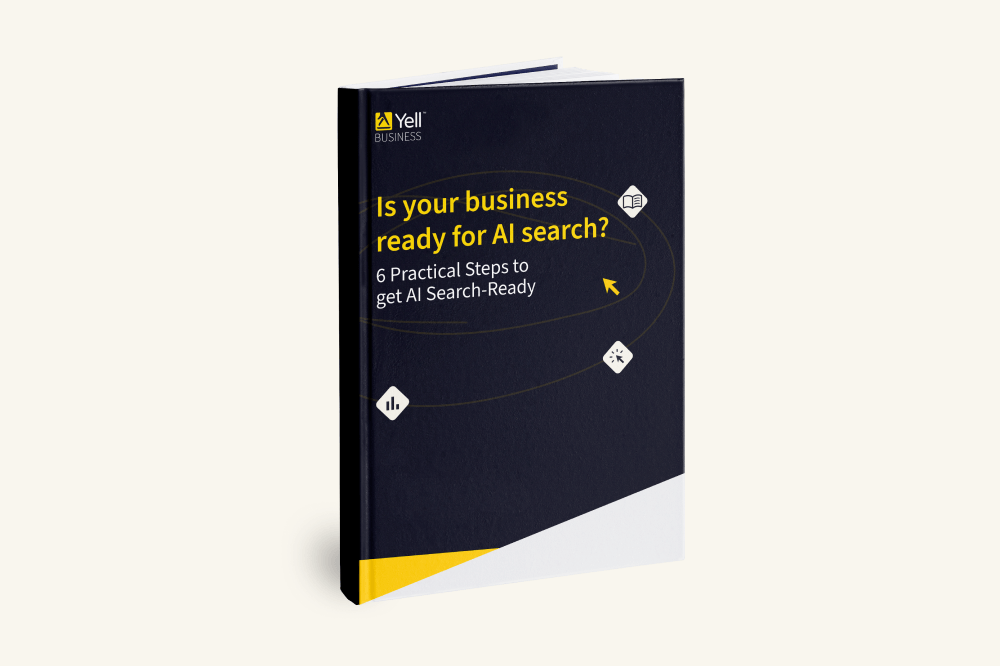
Download our free SEO to AEO eGuide
Want a deeper look at preparing your business for AI-powered search?
Download our free guide for practical, jargon-free steps you can put into action today.
Learn how Yell uses AI to boost visibility
Curious how Yell helps UK businesses appear in both search and AI results?
We work with platforms like Google and OpenAI to help customers get found more often – and waste less budget doing it.